
Secondary School
Academic Rigor & College Preparedness
The Secondary School Program at QSI Shenzhen focuses on equipping students with the skills, knowledge, and behaviors required to be successful in a post-secondary environment.

"At the Secondary campus, students are given opportunities to develop holistically as learners and leaders. By offering a wide range of academic courses, students and parents can develop a customized educational plan that will help students achieve their university goals. Our extensive catalogue of extra-curricular activities allows students to develop the character traits of leadership that will propel them to success at university and beyond."
jessica-hu@shenzhen.qsi.org
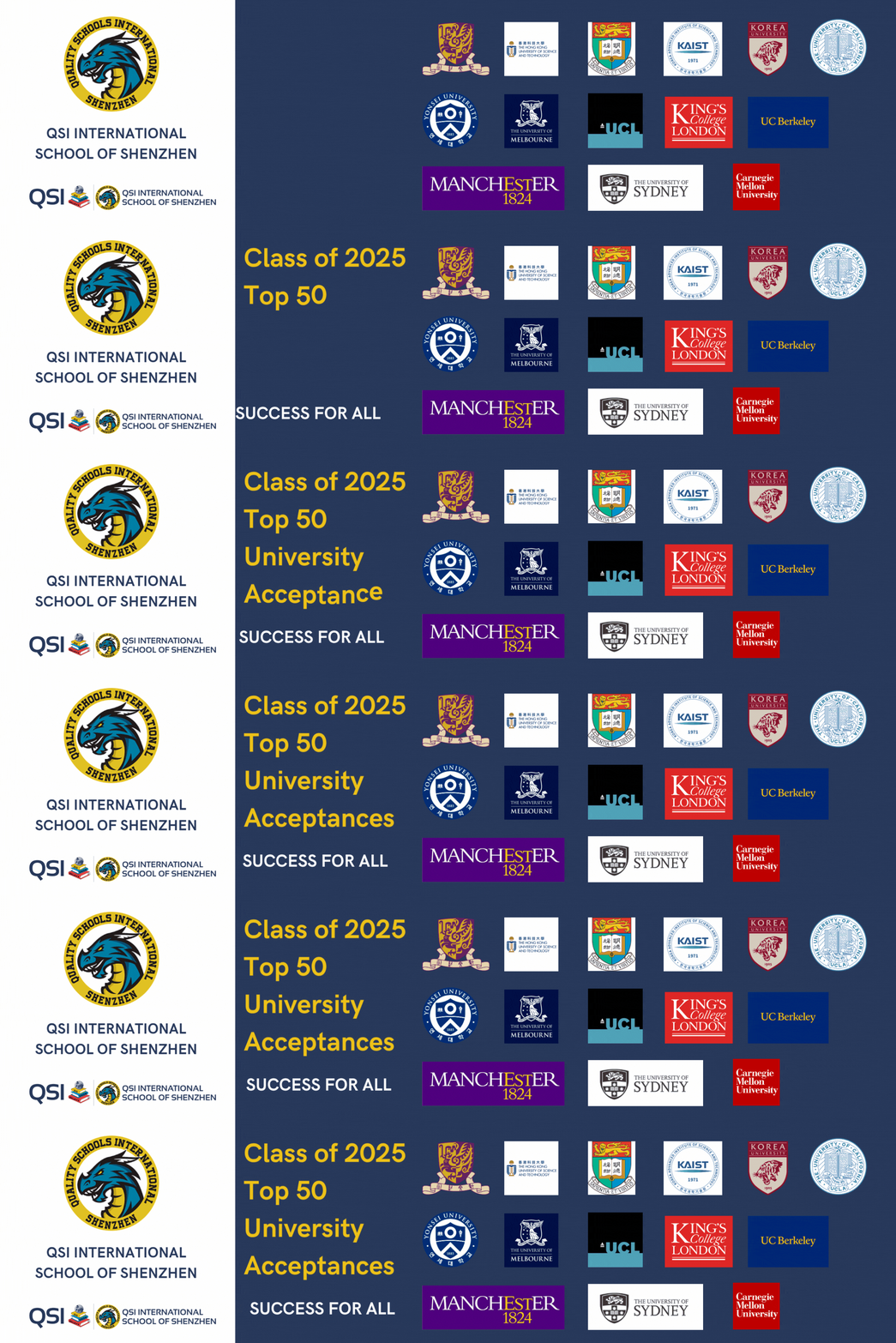
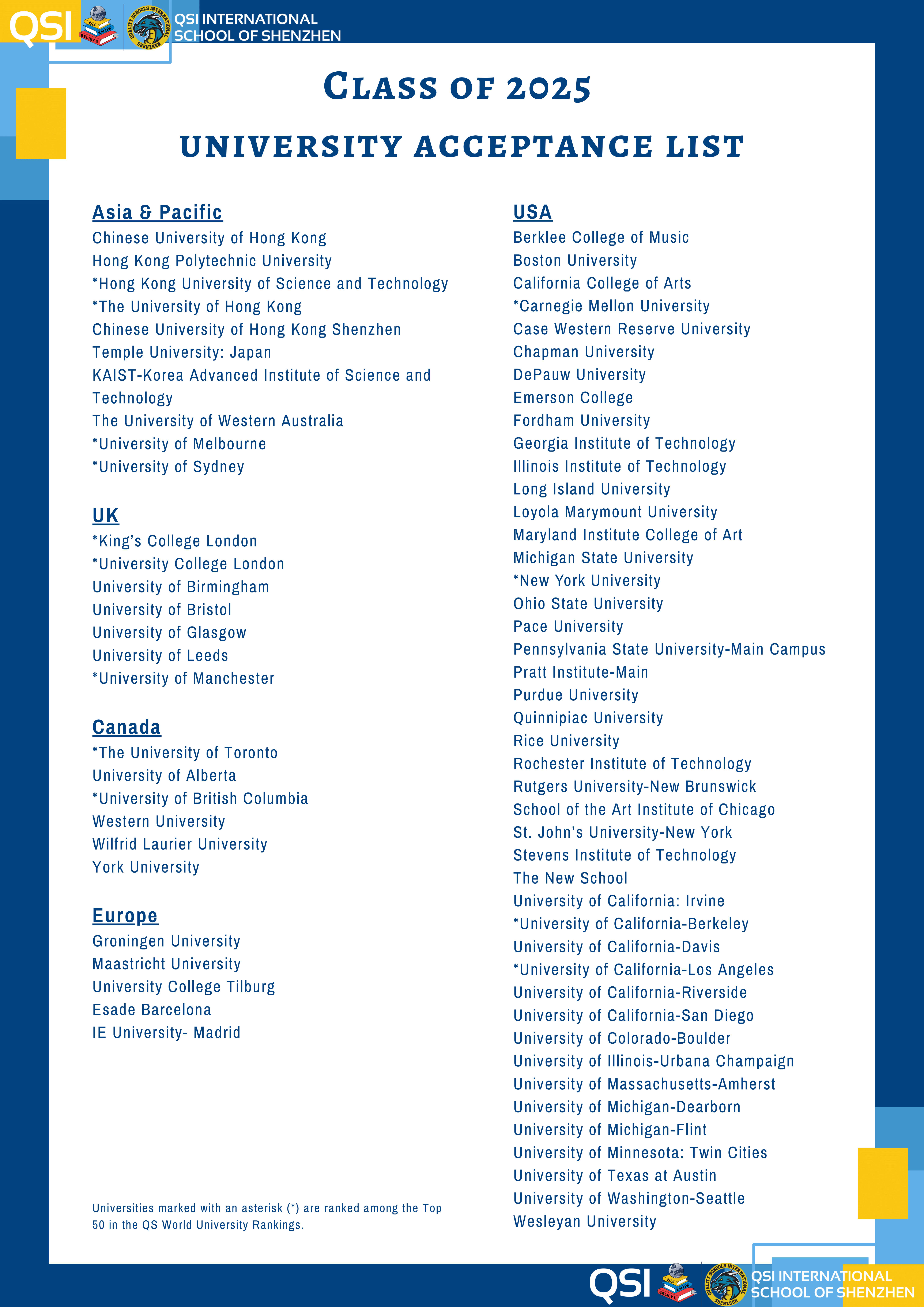
Top 50 University Acceptances 2025
Secondary Diploma Options
Three diploma options: Academic (240 credits), Honors (AP/IB), and IB Diploma.
Admission to Secondary School (Secondary I-IV)
For admission to the Secondary school, students must demonstrate English fluency at the level necessary to be successful in the rigorous courses that lead to the completion of a QSI diploma. In addition to the NWEA MAP test taken during the admissions process (to assess Reading, English Language, and Mathematics), a student's readiness for the secondary program will be assessed with a writing sample and a thorough review of previous school records. Part of the admissions process will include a discussion of the student's potential graduation plan. If a student is denied admission to QSI Shenzhen's secondary program, they will be given a written explanation of the reason(s). Students who are denied admission may re-apply after 6 months.
Day in the Life of a Student
Advanced Placement (AP)
The QSI Academic Diploma with Honors carries with it the same number of required course credits (240) as the QSI Academic Diploma, but indicates that the student has successfully completed at least two Advanced Placement (AP) college level courses sometime during his/her secondary experience. College level credit may be awarded to students who choose to sit for an AP course exam and receive a high enough score.
IB Diploma Programme
The IB Diploma is a diploma that can also earn college level credit. If a student successfully completes all IB requirements and passes the spring exit exams at a high enough level, he/she may be awarded college credit for certain courses, called Higher Level IB courses. Students completing a full IB Diploma Programme of courses in their Sec. III and IV years can earn an IB Diploma in addition to their American-accredited QSI diploma.

Secondary Curriculum
At A Glance
The Secondary follows an eight-course block schedule, with four 85-minute classes alternating every other day. Students have ten minutes of passing time in between classes and a 40-minute lunch. There is also a safety netting period at the end of the school day to allow extra time for schoolwork to be finished.
Classes begin promptly at 8:30 AM and end at 4:00 PM
Teachers and staff are available after school to provide academic support and to sponsor extracurricular activities and athletics.
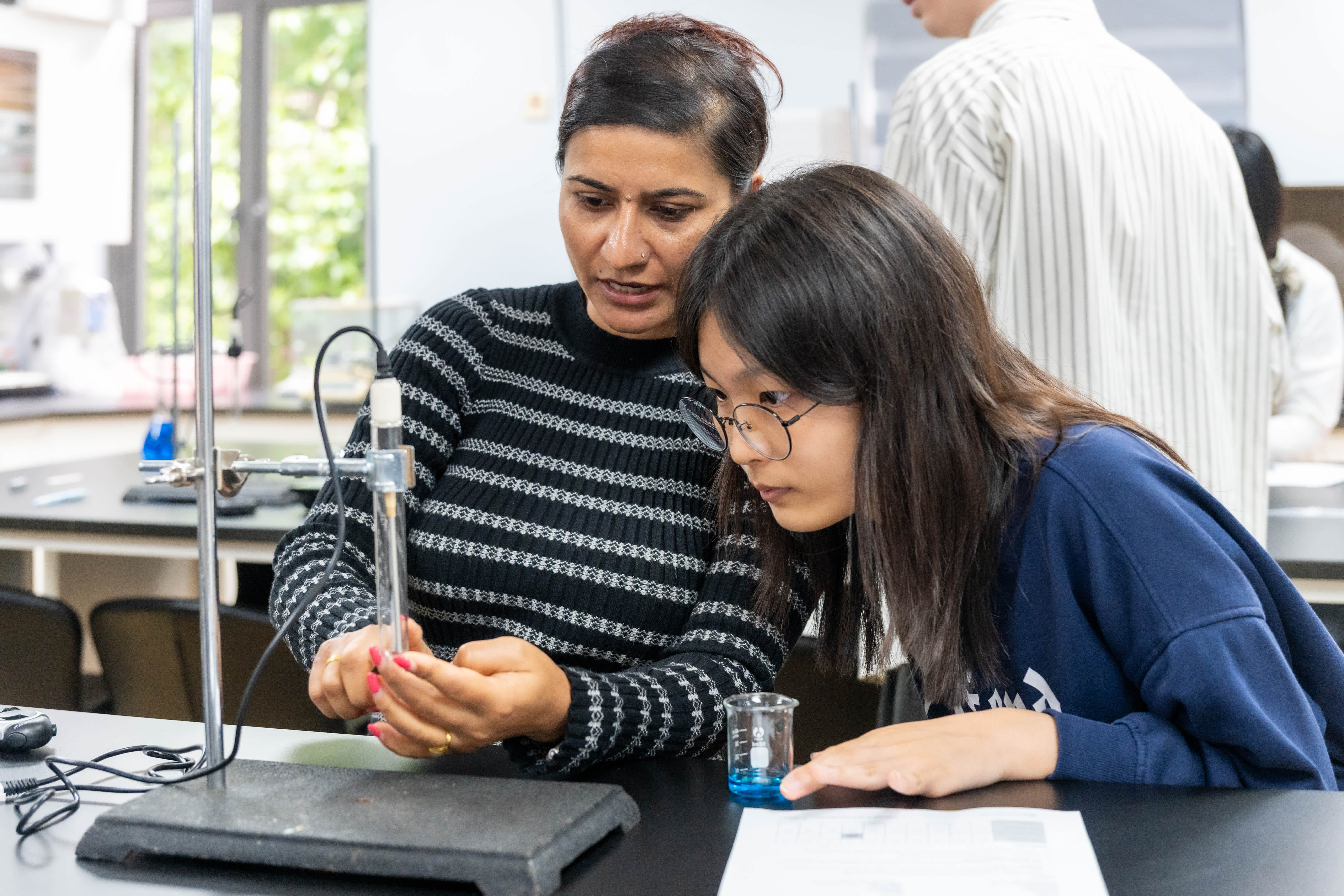
The building contains 31 classrooms, including an art studio, library, computer lab, drama room, music room, fitness room, and a science lab. The building also has a rooftop assembly area and a large common room on the second floor that serves as a cafeteria and multi-purpose space. Physical education classes and sports teams meet at the Shekou Sports Complex next door and take advantage of the full-size double gym, full-size track, and soccer pitch. The building has wireless internet access in all common areas and classrooms. The library is open until 6:00 PM, Monday–Friday, and there is 24-hour security.
Secondary Staff includes 30 full-time, certified, and experienced teachers, mostly from the United States and Canada. The school has a Director of Instruction, Academic Counselor, Librarian, Nurse, and three paraprofessionals.
The Secondary campus is a closed testing site for SAT, ACT, and PSAT exams, offering these exams only to students enrolled at QSI Shenzhen. We offer the SAT in October, December, March, and May, and host the ACT in October and June. All Secondary II students take the PSAT in October.
AP and IB exams are also available only to students enrolled at QSI Shenzhen and take place on our campus in accordance with the schedules published by College Board and the International Baccalaureate Organization.
QSI students participate in a variety of sports, competing against other international schools through our affiliation with the Association of China and Mongolia International Schools (ACAMIS). We offer girls and boys volleyball, basketball, soccer, and badminton.
ACAMIS Arts and Cultural Events (ACE) occur throughout China, and may be available to either or both secondary and middle school students, depending on the activity. ACE Events include such activities as Math Challenge, Model United Nations, chess tournaments, Knowledge Bowl competitions, dance & music festivals, debate competitions, Cultural Conventions, etc.
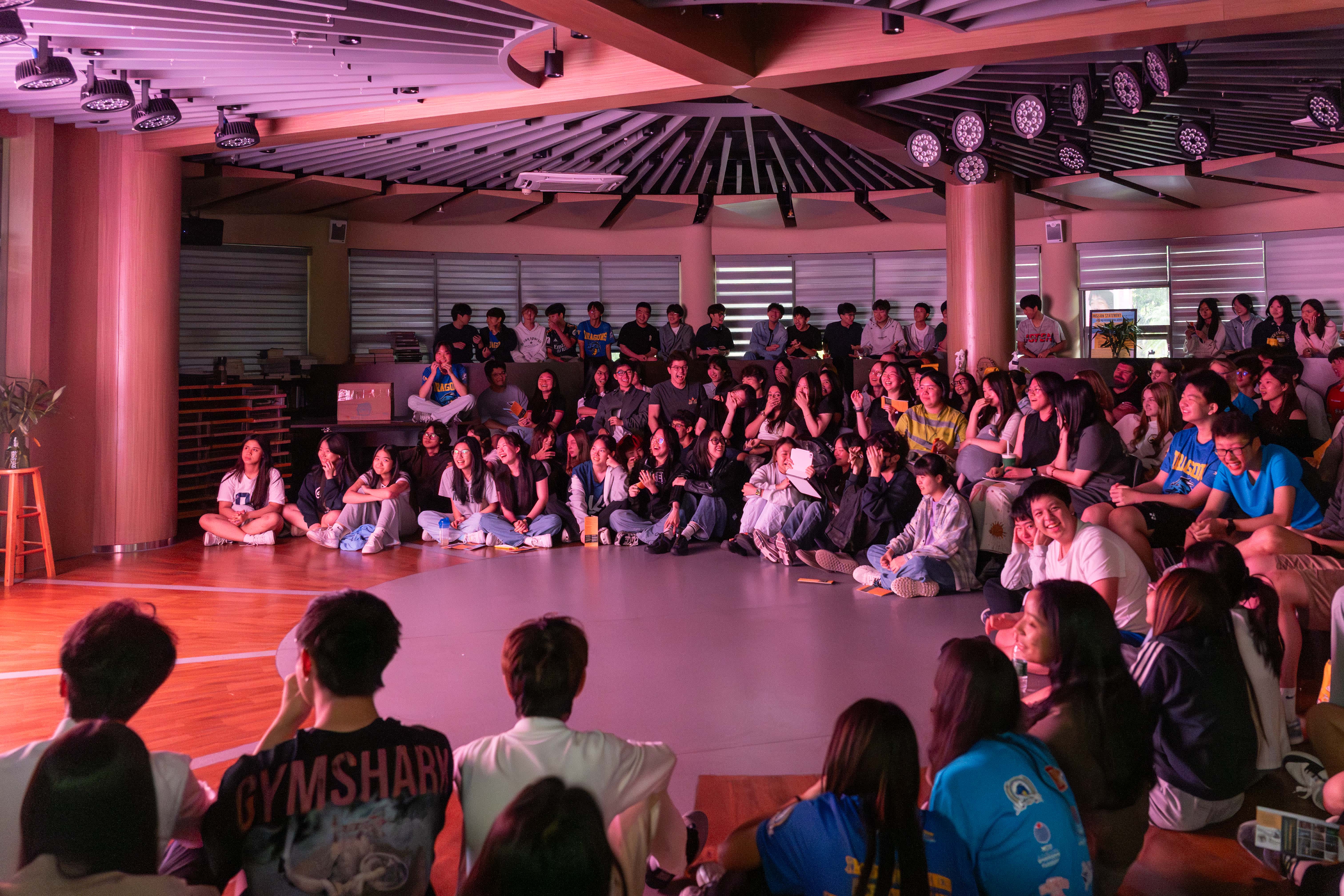
Secondary students have the opportunity to participate in a number of honor societies, such as National Honor Society, National English Honor Society, National Science Honor Society, Mu Alpha Theta, and others. We also encourage our students to form their own clubs based on topics that interest them, and we regularly have over 25 clubs each year in which students can be involved.
In 2016 students from QSI hosted the first Southern China International Model United Nations (SCIMUN). This event is held annually and is student-led, student-initiated, and student-involved. As the largest MUN event in Guangdong Province, leading and participating in SCIMUN is a valuable experience for our students. You can learn more on the SCIMUN website: https://www.scimun.net/