

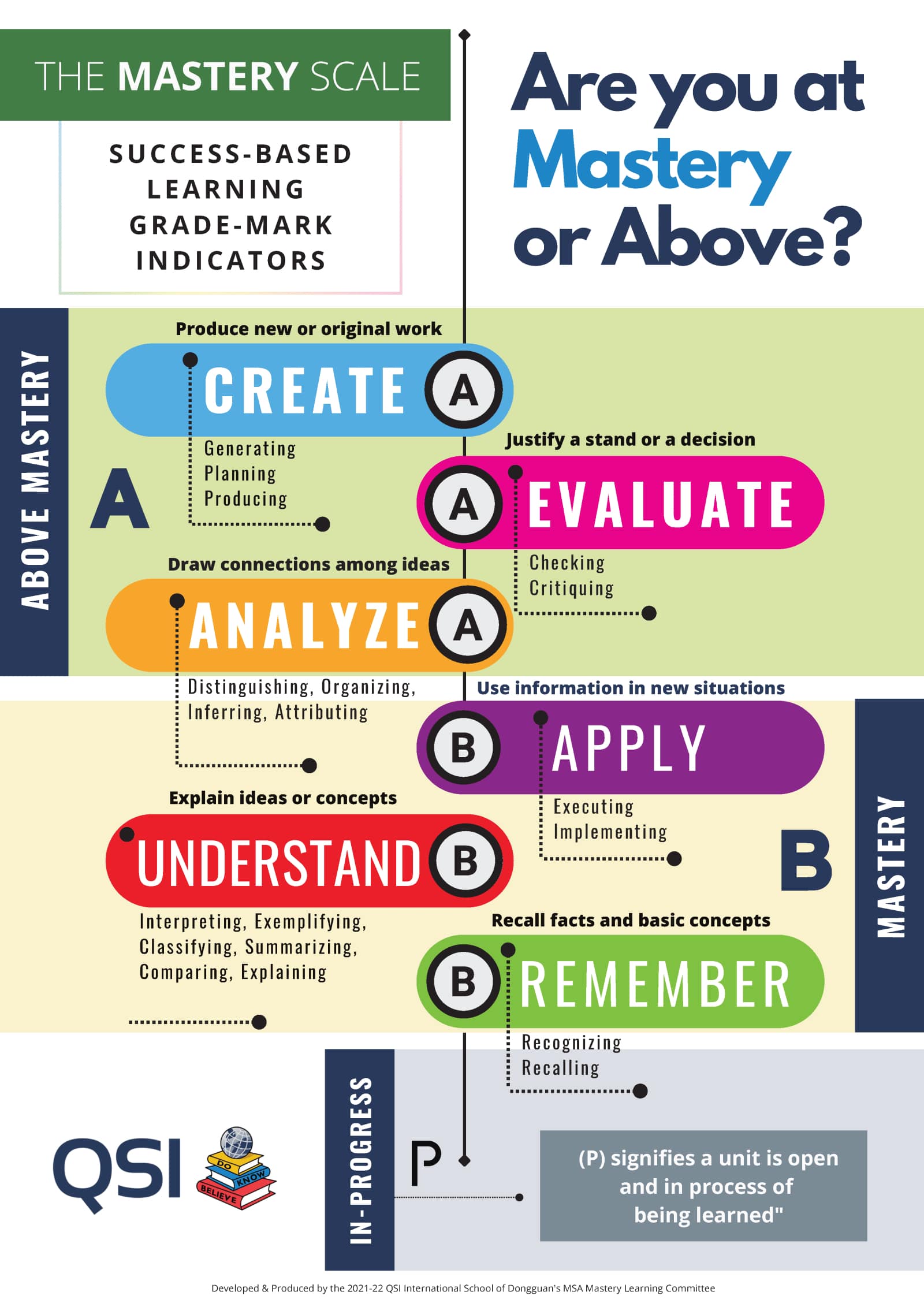
Are you at Mastery or Above?
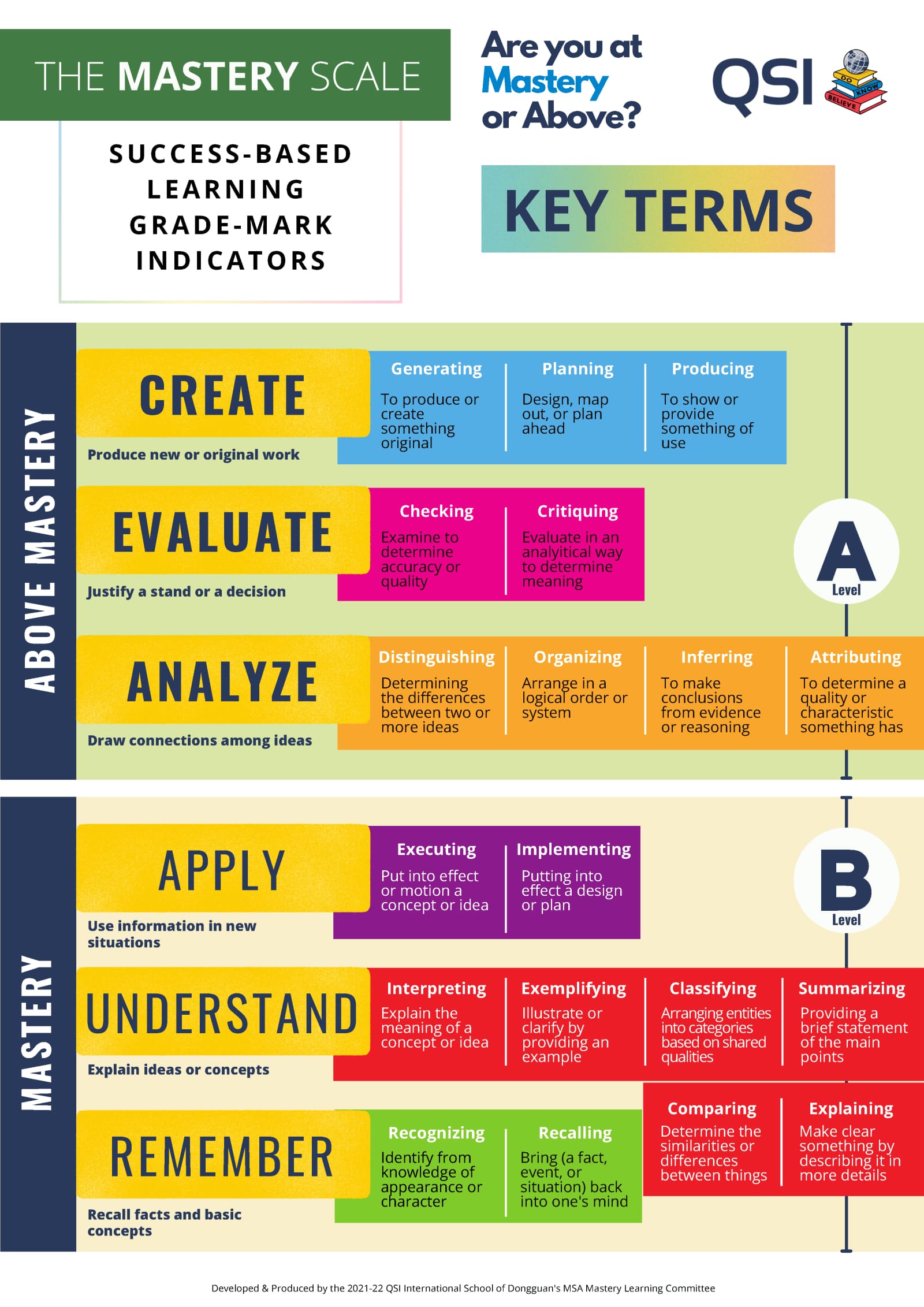
Key Terms for Mastery Learning
Mastery Learning
Mastery Learning is an educational approach in which students must achieve mastery of a subject before moving forward to learn subsequent information; learning builds on established understanding. Students are given the time and support they need to reach mastery.
We choose mastery learning because more students achieve higher and more enduring results.
We expect every student to be successful and we create the conditions for this success through:
- Flexible placement in Reading, Writing, and Mathematics; students are placed in classes where they will be appropriately challenged.
- Instruction based on students' needs.
- Small class sizes.
- Teaching until mastery is demonstrated (low or inconsistent performance isn't good enough to move on to the next course).
- Giving students enough time to master new material so that more students demonstrate proficiency and achievement at higher levels throughout the year.
- Requiring more from students; they are challenged to achieve a deep level of understanding rather than passing a course with only a 70% understanding.
Education That Makes Sense
QSI utilizes the Mastery Learning model when teaching students in our schools. It is a well-researched practice with strong evidence for being highly effective where students learn more information than traditional school methods which receive a percentage grade to pass and move on. Mastery Learning is not a new concept but is starting to become the model for schools looking to reach all students in a more engaging and meaningful way. The idea is simple. In a traditional school, students can pass their courses and miss 40%, 30%, 20%, 10%, and even 5% of the course content. In Mastery Learning schools, we care about the students mastering 100% of the course content. We believe that these gaps in learning, if left unchecked, turn into deficits, difficulties, and frustrations in learning in the future.
Instruction at the Appropriate Level
We believe that success builds upon success. When students master all the learning objectives in one unit, they move onto the next unit. Learning at a level that is too easy may lead to boredom, and learning at a level that is too difficult often leads to frustrations. When students come to a QSI school for the first time, they will take placement assessments in mathematics, reading, and writing. After our initial placement assessment, it may be necessary to do follow up assessments. This process helps the school know just the right placement for new students to be in the right place for successful learning. Teachers use a variety of instructional strategies to ENGAGE all students as they explore the content within each unit.
Assessment FOR Learning
Traditional education systems often identify the gaps without any plan or process to fill them. Mastery learning adheres to the principle that students must demonstrate proficiency or mastery in knowledge, content, and skills. If a student is not able to demonstrate mastery, he or she is provided with additional and differentiated support to first re-learn the material and is then reassessed on it. This cycle continues, similar to one-on-one tutoring until the learner has achieved true mastery. In this way, QSI uses assessment FOR learning, rather than just assessment OF learning.
Time is a Resource
Most education programs have some system of separating students based on academic achievement. It is acceptable for most school systems to teach all students the same things, to give identical exams to assess student learning, and then to observe, record, and report the difference in student achievement. In this scenario, performance becomes the focused variable. In mastery learning, time becomes the focused variable and changes with the intention of increasing all student performance.
Time is not an indicator OF success but a tool FOR success. As such, it becomes one of the most valuable tools for students and teachers. All students are different and enter the classroom with varying levels of language fluency, emotional intelligence, work ethic, curiosity, aptitude for their studies, and degrees of content comprehension. It stands to reason that not all students will be able to reach a high standard of performance at the same time. As a result of varying the time indicator for success, more students are able to demonstrate proficiency and achievement at higher levels throughout the year. As the quality and quantity of time work together to provide a positive learning environment, there is a shift in the perception of time. It is now used as a tool FOR learning that simultaneously develops and promotes a growth mindset. This shift in mindset leads to a solid foundation of learning and a healthy perspective of success that will benefit students throughout their education and careers.
Success Orientations
Many think of school in terms of the 'Academics.' QSI feels it is equally important that the often hidden part of the curriculum is a vital part of the entire QSI school experience. QSI calls these the Success Orientations.
Success for All is the motto of Quality Schools International. This is more than just a slogan. Research indicates, and our experience confirms, that successful people have developed personal orientations that lead to success. Personal habits, the ability to interact successfully with others, reliability, responsibility, diligent work habits, promptness, keeping your word, kindness, and other factors in this realm are at least as important as the knowledge one learns and the competencies one gains. Success in these orientations rests first and foremost in the home; however, the success orientations are actively encouraged and taught in virtually all areas of the QSI school curriculum with the view of making them a vital part of one's life pattern. The role of QSI is to reinforce these efforts of the home.
Success Orientation behaviors are evaluated independently from academic assessments. They are given solely on the basis of student performance in the specified outcomes. The seven Success Orientations are:
QSI Shenzhen\'s Trashion Show is an annual event that celebrates environmental protection, awareness, and creativity. Students design outfits from reused or recycled materials, and the event also links to Group Interaction through collaboration and Independent Endeavour through each student\'s individual design and presentation.
The Student Will (TSW) demonstrate honesty by
- habitually telling the truth and avoiding deception.
- telling the truth when negative consequences may follow.
- bringing lost items or money to the teacher or the office.
- being a person who does not cheat on tests.
- being a person who is not involved in theft.
TSW demonstrate trustworthiness by
- following a commitment with the appropriate action.
- promptly accomplishing an errand when requested by a teacher.
- displaying acceptable behavior when not under teacher supervision.
- being a person who is not involved in vandalism.
TSW demonstrate responsibility by
- coming to school and to each class on time except when ill or otherwise excused.
- bringing appropriate books and materials to class.
- consistently completing assigned schoolwork in a timely manner.
- showing organization and cooperation in completing assigned schoolwork in the prescribed manner (such as name, date, and layout included as directed).
- contributing ideas, reports, research, materials, and/or out-of class involvement which are not assigned.
- taking proper care of materials and equipment.
- taking appropriate action to avoid accidents, to avoid misdeeds, or to aid in a situation of need.
- being careful in making commitments.
TSW demonstrate tolerance for those of other nationalities, races, religions, cultures, ages, and mental and physical abilities by
- being a person who does not make disparaging remarks concerning those different from themselves.
- joining in group activities with those different from themselves.
- having friendly associations with those different from themselves.
TSW demonstrate acceptance of others, particularly newcomers, by
- including them in informal social groups.
- being a person who does not actively exclude individuals from group activities.
- approaching newcomers with a view to making them feel welcome.
TSW demonstrate concern for others by
- avoiding actions or words which hurt another person.
- actions and/or words of support and/or sympathy for those who are unhappy or sad.
- helping others to be successful in their schoolwork, activities, and play.
- displaying unselfish behavior.
TSW demonstrate kindness by
- being a person who does not make remarks which put down another.
- being a person who does not physically abuse others.
- displaying acts of kindness (sympathy, encouragement, helpfulness, patience, etc) toward others, particularly fellow students.
- giving time and resources to help another in need.
TSW demonstrate politeness by
- being a person who does not exhibit rudeness.
- using socially acceptable language.
- displaying acts of courtesy toward others.
TSW demonstrate group involvement by actively participating in activities.
TSW demonstrate support of leadership by
- displaying words and actions which encourage responsible behavior by others.
- displaying words and actions which promote learning in a classroom by others.
- being a person who does not discourage responsible behavior or learning by others.
- assisting the leadership of others by cooperating and being good followers.
TSW demonstrate support of group activities by
- contributing ideas which are related to the goals of the group.
- being a person who does not make negative comments which are not constructive.
- controlling emotions when discussing different points of view.
- displaying kindness when expressing an opinion.
- displaying a cooperative attitude.
TSW demonstrate an appreciation of nature by
- not damaging trees and flowers.
- making positive comments which show appreciation for the beauty of wildlife, mountains, trees, flowers, stars, etc.
- creating artwork which illustrates nature.
TSW demonstrate an appreciation of orderly surroundings by
- voluntarily picking up unsightly litter.
- putting litter in proper receptacles rather than throwing it on the ground.
- keeping areas of work and play reasonably neat.
TSW demonstrate an appreciation of the beauty of ideas; musical, artistic, and theatrical creations; mathematical and scientific concepts; and literary works by
- making positive comments or written reports.
- being a person who does not display negative remarks or actions which show a disrespect for such beauty.
TSW show initiative in engaging in tasks other than those assigned with a view to 'in-depth' study or activity.
- TSW consistently set goals which include more than the minimum effort needed to complete a task.
- TSW have the opportunity to pursue a particular interest in an area not in the curriculum or to pursue a curricular area in depth, having a unit outcome created, evaluated, and credentialed.
- TSW show initiative in using the library and other resources in assignments, projects, and homework.
- TSW show reasonable self-sufficiency in completing assignments, projects, and homework.